Sunday, May 22, 2016

A Day in the Life

Our days usually begin around 06:50 with breakfast in the old house (eggs or granola and a speedy cup of instant coffee if I'm lucky) followed by the muddy, humid, uphill trek to the hospital. Entering the hospital grounds through the red, white, and blue metal gate, we are greeted by the chirping of bright yellow male weaver birds building their elaborate nests and the scent of yellow guava fallen from the trees. We head straight to the ER for morning handoff at 07:30, when the night clinical officer (CO) discusses all of the patients he/she evaluated overnight with the morning staff. Then, it is upstairs to the library where the mud boots come off and we set up shop for the day to work on lectures, research, or other online activities (such as blogging...). By about 10:30, the COs are ready for rounds in both the ER and wards. 

On average, we round on about 25-30 patients. We begin with the "high dependency unit" and pediatric patients in the ER, then move onto the private ward upstairs, followed by maternity, female ward, pediatric ward, and male ward. This takes until nearly 12:00-13:00. Then we lunch in the canteen!  The post-lunch routine is variable -- sometimes we give lectures for medical students/COs, the fellows have meetings, or we continue to work in the library as in the morning. We end our work day around 16:00 and walk back to the "compound."  Shoes get kicked off on the shoe porch, sandals go on, and then it is leisure time. Usually for me this means exercise (running, yoga, Nike Training Club), reading, and playing games. We take turns cooking dinner each night for the "family" and plan out our meals in advance. Last week, Aparna and I made a "tamale pie" although I did not have cornmeal to make the topping so I made up a mixture of corn, breadcrumbs, spices, baking powder, chapati flour, and milk and created my own cornbread. Lance makes some sort of bread it seems almost daily, and he makes his recipe "by feel" which is impressive -- my favorite bread variations so far are the caramel rolls and pizza that we made over the weekend. Cooking together is a nice way to wind down after the day and it is fun to creatively plan meals with the foods we have available. After dinner, we all sit down in the living room to watch pirated movies (Jeffery buys movies from someone in Kisumu, who will put movies on a flash drive for between 0.30-0.50 USD) or play card games (I taught people to play "Chinese Bridge" and learned how to play "Euchre") before bed.  

Weekends are less structured and the fellows are only responsible for rounds. The cool weather in the early mornings is perfect for running, so Aparna and I set out for a 6 mile run Saturday morning. Our route was challenging but beautiful -- the rocky, uneven, dirt roads are lined with blooming bushes with multicolored flowers, quiet farms, and little kids in oversized mud boots. During runs or walks, we are frequently greeted by passerby most often in English ("How are you?, "Fine"), especially the kids, who also love to give high-fives. This area of Kenya is punctuated by rolling hills, making our run particularly exhausting. I spent the remainder of the day recovering in the hammock with a book. 

Saturday evening we went out to celebrate Fred's 30th birthday. All seven of us, plus Fred (who was as usual driving), and three more friends from the hospital packed into a 5 passenger SUV and made the mercifully short trek to Luanda, about 6 km away. We pulled up to a pink building, home to a restaurant/bar called Oasis. Climbing at least 4 flights of stairs, we passed rooms filled with people eating and drinking at each level, to reach the top floor overlooking the tiny main street in Luanda where there was a pool table, TVs broadcasting the Manchester United game, and people sitting at plastic tables eating fried fish, chips, and drinking Tusker beer. We pushed three tables together and ordered food and drinks -- including an entire bottle of Jameson for Fred, which he shared with some of the guys. As a result, after dinner Fred started dancing and convinced everyone to join him. Somehow we managed to get our entire raucous group back into the car and home without any problems. Poa kichizi kama ndizi!

Weaver bird nests


Library Work Room


Canteen


"The Container" (meeting space)

Wards


Emergency Room


Entrance 


Wednesday, May 18, 2016

Return to Africa - The First Week

A year and a half after my last trip to Africa, I am back. My trip to Ethiopia with Auna was a much needed reprieve from the frustrations and pace of American medicine. It felt like a reset. I left Ethiopia with a new found confidence in my ability to practice medicine independently and an appreciation both for the conveniences of life at home as well as the simplicity of a life without constant electronic stimulation, where there was ample time to enjoy the outdoors, exercise, sleep, and read. Here's hoping for similar results from this trip. 

As before, I connected through Dubai but only had a 4 hour layover in the airport, enough time to grab a Coke Light and a quick nap under the desert sun pouring in through the windows. I arrived in Nairoi around 8 PM local time, stayed overnight in a small apartment owned by the MGH program to house visitors connecting through Nairobi, and left for Kisumu early the next morning. It was still dark when I went to the airport and the driver, Jeffrey, pulled up to a checkpoint to enter the airport grounds where we were met with a traffic jam. Many people were getting out of their cars and walking to a sidewalk on the right had side of the road. I didn't understand what was happening at first. Then Jeffrey said, "When we get closer to the gate, you get out and walk with those people to the small building there and go through security. You don't need to take anything." I thought he was joking at first. I have no idea what the purpose of this exercise is -- from what I can tell, passengers disembark and walk through a metal detector housed in a building off to the side while the drivers stop at the security checkpoint and the cars are searched. Then all the passengers wait on the other side of the checkpoint to get back in the car. Given that you have to go through security twice more before actually boarding a flight in the airport, this seems like a meaningless exercise. Despite the delay, I made it to my gate on time for my Kisumu flight. I even had a chance to use 15 min of free internet in the airport -- long enough to find out that oral board scores were posted and that I passed! That was a relief. 

My flight landed in Kisumu just a bit after sunrise and I exited the plane, walked across the Tarmac in the cool morning air to the terminal to collect my bag and find Jeffrey, one of the post-undergrad research coordinators here. I spent the morning in Kisumu with Jeffrey and Fred, our driver, whose birthday happened to be the same day. Jeffrey and I had breakfast at Java House (good food, coffee, and reliable wifi; Jeffrey also bought Fred a piece of cake while we were at the cafe), went grocery shopping at the Nakumatt (impressively well stocked), and then returned to the airport to pick up a pharmacy resident who is also visiting the hospital for a couple of weeks. We then set out for Sagam where the hospital is located, about a 45 minute drive from Kisumu. Thankfully, this drive was significantly less eventful than our cow-dodging trek in Ethiopia. Fred entertained us with his eclectic collection of music, ranging from Dolly Parton to R Kelly. It is the rainy season here, so the countryside along the drive was lush and verdant, dotted with banana trees, hibiscus, and bougainvillea with purple mountains visible in the distance. The road we traveled was apparently once partially unpaved, but was finished recently in preparation for President Obama's visit to Kenya. His family is from Western Kenya near Sagam and there was a possibility that he would travel to this area to see them -- thus, the push to finish the road (the President ended up just staying in Nairobi, however). 

Once we made it to Sagam, we dropped our bags off at the house where I am staying during my visit. I am living with six other people at the moment, although this number will fluctuate during my month here. Currently, there are two Global Health fellows (my friend Aparna and Priyanka, a family medicine doctor), a pharmacy resident (Steven) and three research coordinators (Molly, Lance, Jeffrey -- they are all med school bound in the fall). Just before Steven and I arrived, the group had partially moved into a new house. Both houses are located on the same property, the new space is just up a small grassy hill from the original house, but we are splitting our activities between the two because of some finishing touches (hot water, window screens, etc) missing in the new house. Essentially, we only sleep in the new house and socialize, shower (if you prefer warm water), watch movies, and cook meals in the old house. 

The property on which the houses are situated is secluded and peaceful. It is about a 15-20 minute walk down rocky dirt roads from the hospital to the property, which is tucked back away from the road and surrounded by tall shade trees. The grounds are well kept with garden beds at the bases of the trees, pink roses blooming in the yard, and monkeys, chickens, and one small tri-colored dog roaming the area. The new house is two stories and is spacious -- with 10 bedrooms, 4 bathrooms, a kitchen, and two living areas (one upstairs and one downstairs). The old house is a single story bungalow with a  long front porch that is truly multipurpose -- there are table and chairs where we sometimes eat, play games, or just hang out and relax; a hammock, which is the best reading nook; work out equipment consisting of two yoga mats, an exercise ball, and two sets of hand weights; and a diverse, plentiful collection of footwear ranging from mud boots to running shoes to flip flops. In fact, about a fifth of the porch serves as the shoe holding area. The inside of the old house has a small kitchen with a stocked pantry, a projector for watching movies, two old comfortable couches, and most importantly flushing toilets and hot water. 

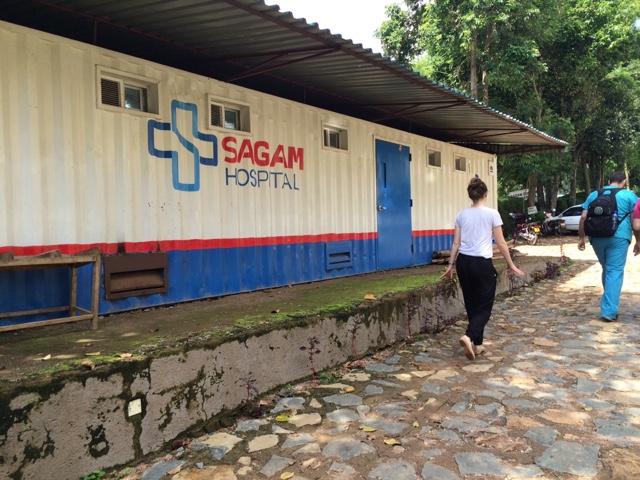
Jeffrey took us on a tour of the hospital next. Sagam Community Hospital is much bigger than I expected. It consists of a clinic/OPD building, a female ward, male ward, pediatric ward, maternity ward, a new ward with private rooms (mostly empty the majority of the time), radiology department, pharmacy, operating room, and a large ER that has a separate section for pediatrics (3 beds) and a high dependency unit (basically the ICU equivalent), a library where the fellows/coordinators work during the day, "the container" which is a trailer that serves as a meeting space, and the canteen.  We ended our tour in the canteen where we met the rest of the group while they were lunching. The canteen is also a tiny trailer-like structure with white plastic tables and chairs, an abundance of flies, ice cold orange Fanta and water in the fridge, and menus scattered about with a food list that vaguely resembles what is actually available. But the food is so good! You order at the window/Dutch door to the kitchen, then write your order in a notebook under your name so you can pay later. Lunches here take about an hour to finish, the food is far from fast, but it is refreshing to take the time to sit and relax after the morning of work. My favorite foods so far are chapati (a flat bread similar to naan), a dish we call "Rolex" (although I'm pretty sure it is actually "roll egg") which is fried egg rolled up in chapati. Other popular dishes are warm cabbage salad, sukuma (kale/collard green-like veggie), beef stew, and mandazi (Kenyan version of doughnuts). The Kenyan favorite is ugali, which is basically a bland dense cornmeal paste brick. 

After a week, I am now settled into the routine of life in Sagam...stay tuned!


View of the hospital

A visitor outside the kitchen window


Roads between the house and hospital


The new house and the yard


Shoe porch


Dog friend


Reading hangout


Friday, December 12, 2014

Last Things

Our trip has nearly come to an end.  We could not have asked for a better experience.  We saw so much in a short period of time, patients that presented as textbook perfect cases of diseases, some of which we have only read about.  We also developed some basic McGuyver skills, creatively fashioning solutions out of next to nothing.  We learned to be conservative in how we practice medicine, not by ordering a battery of tests to protect ourselves, but by using only what is necessary for diagnosis and treatment and nothing more.  We had to think more about our resource utilization, which made us think more about our physical exam, bedside ultrasound, and our differential diagnosis before we planned our work up and disposition.  We are better doctors because we had this opportunity.

While the medical experience was extremely rewarding, our experience would not have been the same without the people who helped us each and every day.  Our Ethiopian nursing staff in the ER made each shift a joy.  They tirelessly translated for us 'ferengis', proficiently navigating some difficult cultural and ethical situations and kindly but firmly redirecting patients who strayed from the questions we asked.  Sometimes we asked them to do something differently than they are accustomed to, or we wanted to do something that was brand new for them in the ER, and each time they were eager to learn and happy to help.  The GPs that we worked alongside were also invaluable resources -- we taught them a few things about airway management, central lines, ultrasound, and chronic diseases like AMI and stroke, but we learned so much from them in return-- they are experts in tropical diseases, they helped us broaden our differentials to take into consideration the disease processes that are common to this particular area, and they showed us daily how to make the best use of the system we had available.  They work extremely hard and they do not complain.  They were thankful for our help in the ER, but we were equally thankful for everything they did for us and for the work they do each and every day for these patients.

Finally, the Gabrysch family and all of the other missionaries at SCH were wonderful hosts.  Everyone was welcoming and generous, and it was nice to both live and work among them as part of their community for short time.  Jeremy especially was instrumental in making this a successful and rewarding trip.  He helped us immensely in the ER, we learned together as a team on some complicated cases, and more often than not if we called him to ask a question he dropped whatever else he was doing to come see the patient alongside us.  He even let us babysit his amazing kids for a few hours, but after keeping them up way past their bedtime playing games, I'm not sure we'll be invited to do that again!  Christina and Jeremy also let us crash their short vacation to Lake Langamo on the way to Addis before we all leave for the United States, which was relaxing and fun.  Plus, we got to spend some more time with the kids, both of whom are full of energy, very entertaining, and a joy to be around!

We will miss this place.  It will be quite a shock to be back at county in just a few days compared to our lives for the past month, but this was a welcome and refreshing interlude before the home stretch in our final year of residency.  Thank you again to everyone at home who made this possible for us, we love you all and we will see you soon!


New Airway Cart in the ER.  We finally completed this during our last shift!


Relaxing on the beach!


Fun in the car and kid-sitting shenanigans!


Wednesday, December 10, 2014

Top 10 Things You Should Probably NOT Do In Africa:

1) Drink from the rivers
2) Pet a warthog
3) Go on a safari...on foot
4) Swim in African lakes
5) Ride in a boat among hippos and crocodiles
6) Text, talk, or even think about blinking while driving
7) Walk around barefoot
8) Ride on top of any vehicle, especially an oxen lorry
9) Get into a tussle with livestock
10) Tell your husbands 'If you don't hear from us in 24 hours we were eaten by crocodiles'

We've only done a few of these...we'll let you guess which ones!


Sunday, December 7, 2014

It's Cultural

The night before the Wegner family left for the Congo, we had the opportunity to experience an Ethiopian coffee ceremony in our guesthouse.  This ceremony which is done for visitors to Ethiopia, friends and also on special occasions/religious holidays involves the roasting of green coffee beans over hot coals with incense (frankincense, myrrh), followed by the grinding of the beans usually with a wooden mortar and pestle and heating of water with the grounds in a jebena over the same fire.  The coffee is served with snacks (most often popcorn here).  The coffee with thick, rich, and not at all bitter.  We sat on our back porch for the ceremony and talked shop with Stephen while Anna laughingly complained that she needed new friends until the sun started to sink in the sky.  It was a nice way to punctuate the end of their time here.

The following day, we were invited to speak at an English class for young Ethiopian students between grades 3 and 7.  We weren't sure what to expect, the only advice we received was "just talk about where you are from and show pictures if you have them."  We stepped into the small classroom on the hospital grounds and were greeted by a smiling group of clapping children, singing us a welcome song in English.  Their instructor, Paulos, asked each student to stand up and say their name, grade, and school and then ask us a question about ourselves in English.  We were asked our names, where we were from, about our siblings/husbands/families, and about our favorites (food, colors, activities, etc).  Then we showed the kids pictures on our phones of our family and our dogs.  Paulos asked if we had other pictures of animals and I happened to have photos of a duckling and of a moose on my phone.  The kids recognized the duck easily, but the moose was a tough one -- cow, horse, and buffalo were popular guesses, only one little boy in the middle of the room recognized it.  Turns out, the word "moos" in Amharic means banana.  We all learned something in English class!

The meaning of names is important to Ethiopians and being asked what your name means after an introduction to someone is not uncommon.  We had to do a little research when we got here because neither of us really knew the origin of our names -- Kelsey means "ship's victory" and Auna means "grace."  Ferengi names can be hard for Ethiopians to pronounce, so when Jeremy first introduced us to people here, he tried to help by comparing our names to Amharic words -- Auna is similar to the word for "and" and has sounds common to Amharic.  Kelsey is closest to the word "kalsi" which means "socks."  Awesome.

Probably our favorite cultural discovery here is the Ethiopian gasp.  It wasn't obvious immediately, but as we became more accustomed to listening to our patients speaking Amharic and interacting with Ethiopian consultants, we started to really notice the gasp.  It is a noise that indicates agreement, kind of like our "uh huh" in conversation, but it is startling, especially in an emergency room!  Every time we heard a gasp, we'd look around for a femur fracture,  profuse bleeding, impending death but we would find...NOTHING!  Just a happy, agreeable patient before us.  This blog post really sums up exactly how the gasp strikes you when you first hear it: https://aloneinastrangetown.wordpress.com/2012/11/14/the-ethiopian-gasp/.  Please forgive us if you notice us gasping when we get back...it also seems to be contagious. Gasp!


English Class


Coffee Ceremony


Thursday, December 4, 2014

Another week in Soddo


The sky is slowly turning from dark black to light grey.  You can start to see the outlines o the palms and avocado trees rocking in the wind.  They are strong, they've done this dance many times before.  It  is windy nearly every night. The sounds of gates, windows, and other lose pieces of hardware banging sporadically through the night sound much scarier in the dark.  The doors of the house moan and creak in the wind storm. It reminds me of a beach house - loud but resilient.

The family we share our guest house with is leaving today.  It's going to be strange to have the house so quiet. There are three kids in the family who can most often be found in avocado trees and sitting on top of swing sets (not anywhere near the actual swings).  We asked their daughter how she got on top of the swing set once and she replied, "it's easy, it's just like when you're climbing up walls." We will miss their company.

This week has been filled with more of the same in the ER, but as we sat in our living room last night swapping case stories with a couple (ortho resident and FP doctor) who arrived this week, we realized we are so absurdly excited about the patients we have seen here. We showed them pictures and described things we have read about but never seen before. We talked about the highs of our triumphs and the lows of our failures.  Although working in a county hospital makes you somewhat accustomed to witnessing the suffering of the world, it still hurts to see patients in pain or dying, especially from things that seem so easy to treat at home.  But, like most ER docs, we keep working in hopes that our next patient will have a better outcome.

The highlight of our week was a very critical patient who we were able to resuscitate enough to get him to the OR. We had to place a central line and start him on vasopressors in the ER. The nurses haven't done this before, so it was up to us to mix our own dopamine drip (the only pressor available that day). There aren't IV pumps available to adjust the rate of infusion either, which means we also had to calculate a rate....in drops per minute.  We mixed our concentration of dopamine into 1 liter of normal saline and then converted the dose we wanted our patient to get from mL/min to drops/min so the nurses could count approximately the amount of pressor the patient was getting per minute. Who says doctors can't do math?!  So far he is doing well post operatively.

The sky is bright now. Coffee is ready. Time to head off for another day.

P.S.  Some of our patient stories are intentionally vague.  Every single day here we have patients with shocking physical findings, great radiology studies, or interesting stories or we get to do procedures we've never done before, but we are trying to save some of the details to share with our UTSW residency friends at home...can't give away the answers too soon!


Tuesday, December 2, 2014

Weekend Edition

We were off for the weekend as far as ER work goes, but did work on some side projects (stocking an airway cart, updating the pharmacy formulary list, etc) and celebrated a second Thanksgiving on Saturday with a real American turkey.  For the past two weeks, we have been making mental notes of all of the ways working in Soddo is similar to and very different from working in a county hospital.  So, here is our top 10 list!

Top 10 Ways Soddo is County
1) Throngs of people waiting, everywhere...in the hallway, waiting room, outside, on the lawn, etc
2) We talk to patients in a chair, then examine them in a bed
3) Everyone has at least one non-specific complaint that is potentially a sign of bad pathology
4) Some patients just want to be radiated, even when it is not clinically indicated
5) In theory, we can use ketamine
6) Translators are a precious resource
7) We prescribe medications based on whether our patients can afford it
8) The nurses know what to do in emergencies, and they act immediately
9) The to-be-seen list is never zero
10) It is fun, rewarding, and exhausting

Top 10 Ways Soddo IS NOT County
1) Everyone takes a lunch break, including patients
2) People rarely complain of pain, and ibuprofen works
3) Hypoxic patients walk to x-ray, not to a booth
4) Fractures are treated immediately
5) GCS < 8 does not mean intubate
6) Anything that ends in -itis might be tuberculosis
7) People pay for their medical care (and stay in the hospital until they can pay, instead of being discharged)
8) Hand sanitizer and PPE are precious resources
9) Long ER dwell times, but patients wait at home and return for results the next morning
10) Clinics can actually see patients on the same day they are referred

Weekend relaxation below...